Himalayan Buddhism made simple for non-Buddhists: Iconography
Buddhism is practiced by the majority of South Asian countries, but Buddhism in the Himalayas has a distinct vibe that resonates on a personal level, even for non-Buddhists. In my 20-plus years of guiding foreign tourists in the Himalayas, I have observed a great deal of interest among them, which hasn’t waned at all, making me realize that people genuinely want to understand Buddhism in the Himalayas. In the meantime, interest in Buddhism among our residential holidaymakers has also steadily grown over the last decade, especially among the younger generation.
There already exists an immense library of information on the internet. However, it also makes things complicated for the non-Buddhists who want to start the journey to understand Buddhism practiced in the Himalayas. The internet searches either bring you to the generic information that is of little help, or an expert outlook that will only add to the anxiety, leaving you with a seemingly insurmountable challenge of exploring a subject as vast as Buddhism.
We have all been students in our lives, some of us still are. Learning becomes an enjoyable process if we set our priorities right. Whenever I start to learn something new, I make sure to note all the important or popular points so that I am in the loop of the subject matter I am learning.
For instance, when I was learning German, way back before Duolingo came into the scene, I used to make notes of popular German music bands, famous German movies, literature, authors, names of politicians, etc. All of these are subjects of my interest, so these made my learning more enjoyable. Likewise, to understand Himalayan Buddhism, it is advantageous to learn the following elements. Reading the list of essential topics below will help you subconsciously tread this customized path to learning more about Himalayan Buddhism.
What makes Himalayan Buddhism, or Vajrayana Buddhism, so attractive?
Firstly, let me clarify that I have used the term ‘Himalayan Buddhism’ for the sake of the narrative. There is no such sect of Buddhism called ‘Himalayan Buddhism’. A more proper term would be ‘Vajrayana Buddhism’. Now, to answer the question, I believe the following reasons are the magnetic factors of Himalayan Buddhism.
1) Iconography:

Himalayan Buddhism is replete with aesthetic artworks. Whether it’s the murals on the monastery’s walls, statues of handsome Dhyani Buddhas, or the masks of fearsome protector deities, an admirer of art can immediately feel the pull towards these fascinating representations of the believers’ faith.
2) Monastery:

Buddhist monasteries in the Himalayas are grand and attractive. Ancient structures made of stone, wood, and earth are like the living monuments from the bygone era. The calm and colourful interior, decorated with wall paintings, thangkas, the flowing hanging brocade banners, the collection of statues of all sizes on the altar, and the instantly eye-catching bowls of offerings in front of them, all make for an out-of-the-world ambience for non-Buddhists.
3) Monks:

One of the sights that makes visits to the monasteries so fascinating is the gathering of monks, either studying, debating, or playing football, cricket, basketball, and sometimes even baseball. They are shy but approachable. The little ones are endearing, and the elders give a very wise and calming vibe.
A learning hack that will help you master the Buddhist iconography.
The Buddhist iconography appears complicated to non-Buddhists. But is it really that complicated?
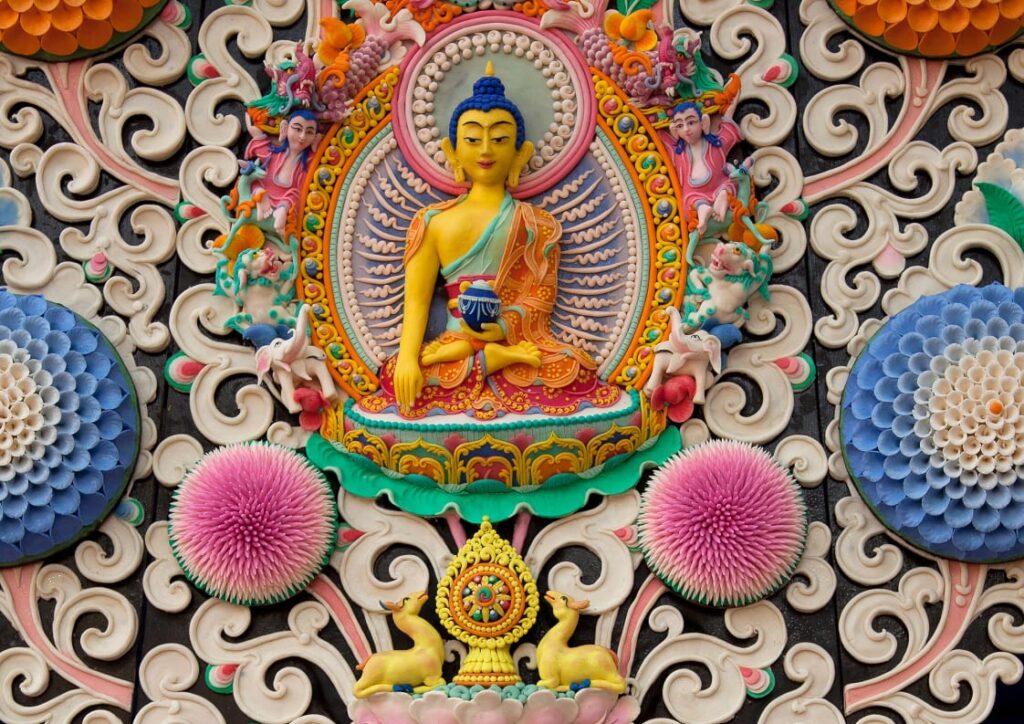
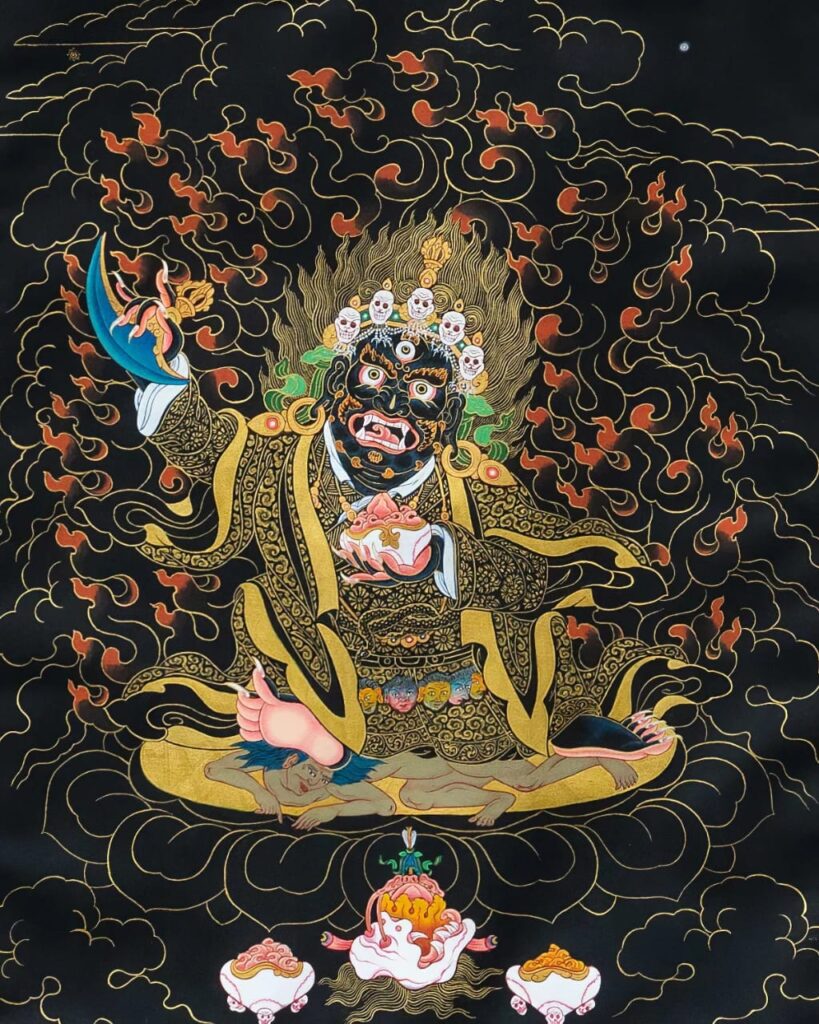
a) Learn to visually recognize these five Buddhist deities: (Check the “Distinctive identification guide” provided in the caption of each pic)
1) Guru Padmasambhva (also known as Guru Rinpoche)

2) Shakyamuni Buddha
3) Chenrezig

4) Drolma (Green Tara)

5) Yeshi Gonpo (Mahakala)
b) Discover the five directions with the five Buddha families.

Unlike the four cardinal directions we are taught in schools, the world of Vajrayana Buddhism has five directions, each ruled by five Dhyani Buddha families. The directions are East, West, North, South, and Centre. (You can learn about the Dhyani Buddha families after mastering the first five deities above). Understanding the existence of the five directions will help you acknowledge further information clearly.
c) Recognize the five colours of Himalayan Buddhism through the prayer flags

From the high mountain passes of Ladakh in the west to the narrow vallleys of Arunachal Pradesh in the east, you will find these five colours greeting you at every village, bridge, monastery, house, cafe, hotel, restaurant, car, and even motorbike. The most prominent form you will notice is the popular prayer flags. The five colours represent the five elements. From the ascending order, the colours and corresponding elements are as follows: Yellow (Earth) > Green (Water) > Red (Fire) > White (Air) > and finally Blue (Ether/Space). These colours should not interchange, and should always follow the order, especially in prayer flags. Later, you will also realize that these colours and elements apply to the Buddhas and Buddha families as well.
d) Know your Thangka

The Thangka is a sacred painting used heretofore by nomadic Buddhist tribes during meditation, teaching, and rituals. Its tradition continues today, with non-Buddhists even using it as decorative items in their living rooms. The souvenir shops sell many variants of the Thangka, from a few hundred rupees to a few hundred thousand rupees. For Buddhists, they are venerated relics passed down through generations.
e) Acquaint yourself with the “Sipa Khorlo” – The Wheel of Life

This ubiquitous painting on the walls of monasteries, and thangkas, of the Tibetan-Himalayan belt are both fascinating and mystifying.
The outer circles with 12 different partitions are the representations of our earthly life. The inner circle with 6 partitions is the six different realms of our pasts and futures, depending on our karma (deeds), the third circle with a black and white partition is the depictions of journeys from the upper realm to the lower realm and vice-versa, also dependent on our karma. Finally, the fourth, and the innermost circle, represents the three poisons of life corresponding to the three animals: pig – ignorance, rooster – desire, and snake – anger.
The red demon-like figure holding on to the circles (wheel), with his teeth and claws, represents the impermanence of life. The presence of the Buddha and the moon represents liberation from the wheel of life.
Buddhist iconography is a colossal subject that begins to open more as you understand more. Start with knowing the most visible figures. That will boost your confidence and give you the impetus to proceed further. Good luck!

Vishal Eli Chamling
Add New Comment
Add Comment